Ringier AG / Blick
Confirmed on appeal167 articles of a media campaign against a single person. Severe personality rights violation established by the court, Blick apology on the front page. For the first time in Switzerland, a media corporation is ordered to return profits from personality-violating reporting. On 19 June 2026, the High Court of Zug confirmed the profit disgorgement on appeal; not yet legally binding.
Video · 3:22
The headlines of the Blick campaign 2014 to 2015
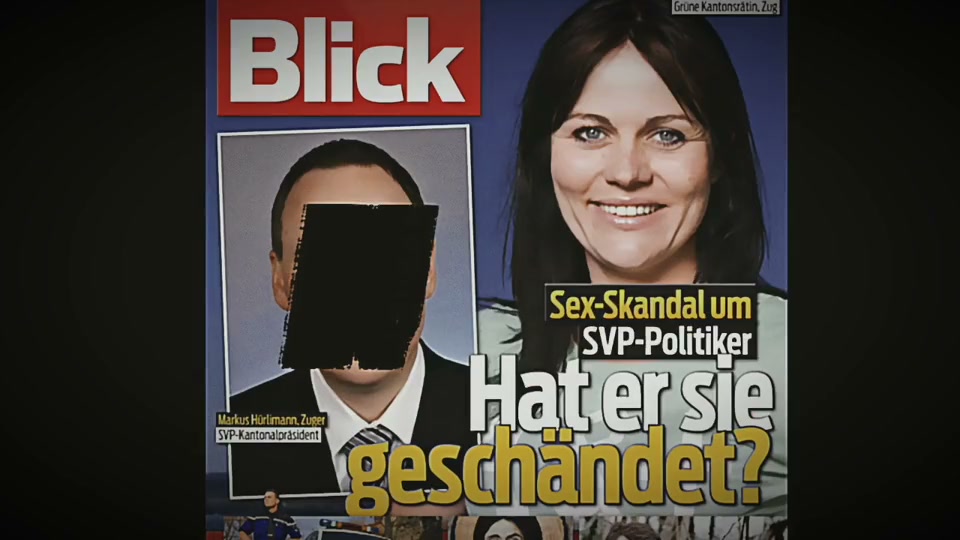
A selection of at least 167 Blick items, read out with the publication and the by-line; plus headlines from Blick am Abend and Tages-Anzeiger. At the end, the apology of Ringier CEO Marc Walder on the front page of 25 August 2020. In German. Play the video (3:22).
From the file
Timeline
-
Dec. 2014
Blick Front Page: "Was She Assaulted?"
On the morning of 21 December 2014, at around 10 a.m., Jolanda Spiess goes to the Zug cantonal hospital with lower abdominal pain, a complete blackout spanning several hours and the suspicion that she had been drugged without her knowledge. On 24 December 2014, the Blick front page publishes the headline with photos and names of those involved. It marks the start of a media campaign. 167 Blick articles and videos follow – without consent, generating millions of clicks and massive advertising revenue for the corporation.
-
2016–2017
Press Council Ruling and Civil Lawsuit
The Swiss Press Council rules in 2016: Blick violated private and intimate privacy; the identifying reporting should never have occurred. Blick does not publish this ruling. In 2017, Jolanda Spiess files the civil lawsuit for the personality rights violation. It becomes the basis for the later profit disgorgement under Art. 28a para. 3 ZGB, the first-ever application of this legal instrument against a Swiss media corporation.
-
2019
Cantonal Court: "Severe Personality Rights Violations"
The Zug Cantonal Court rules: Blick committed "severe personality rights violations"; the identifying article from Christmas Eve 2014 constituted a "gross intrusion into intimate privacy." Publishing names and photos was wrong. Ringier appeals.
-
2019
Fairmedia Crowdfunding
When it becomes clear that Ringier will not accept the ruling, Fairmedia launches a crowdfunding campaign. 1,000 people participate, raising over CHF 60,000 in short order. This enables the continuation of the proceedings.
-
2020
High Court Confirms – Blick Apologises
The High Court confirms the ruling on appeal: intimate privacy was violated "in a serious manner." Ringier accepts. Blick writes on its front page: "Apology, Jolanda Spiess." It marks the end of the Blick campaign – and the beginning of the profit disgorgement lawsuit.
-
2022
First Interim Decision on Profit Disgorgement
The Zug Cantonal Court affirms the profit disgorgement claim: Ringier must disclose the figures. Four personality-violating articles from the original Blick campaign are identified. The path to calculating and surrendering digital profits is paved.
-
2023–2024
Expert Report on the Calculation Method
In the first-instance proceedings, Jolanda Spiess submits a report by three experts setting out how digital advertising revenues can be attributed to individual articles. Ringier, for its part, commissions a comprehensive counter-report from PricewaterhouseCoopers (PwC). The claim that online profits cannot be broken down to individual articles thereby becomes judicially verifiable.
-
22 January 2025
Landmark Ruling at First Instance
The Zug Cantonal Court orders Ringier AG to surrender the profits earned from four personality-violating Blick articles (Art. 28a para. 3 ZGB in conjunction with Art. 423 OR). For the first time in Swiss legal history, a media corporation bears an economic price tag for personality rights violations. The ruling is at first instance.
-
2025
Appeal before the High Court of Zug
Ringier appeals the ruling to the High Court of Zug. The High Court decides on the basis of the case files, without an oral hearing.
-
19 June 2026
High Court of Zug Confirms the Profit Disgorgement
The High Court of Zug confirms the profit disgorgement claim against Ringier AG on appeal. It confirms the calculation method and the principle and adjusts two calculation figures downward: on average around CHF 35,000 per article, plus five percent default interest since 2014/2015. The amount and the allocation of costs may be disputed, but not the principle – anyone who earns money by violating personality rights must surrender that profit. The ruling is not yet legally binding: Ringier has appealed to the Federal Supreme Court (confirmed to SRF, 4 September 2026).
-
Outlook
Campaign Lawsuit: The Remaining 163 Articles
The profit disgorgement ruling concerns four articles. In total, Blick published 167 pieces as part of the campaign. A campaign lawsuit for the remaining articles is in preparation. The precedent has been established – applying it to the entire campaign is the next step.
Personal statement · June 2026 · Excerpt
Profit Disgorgement against Ringier – Confirmed on Appeal
The Higher Court of the Canton of Zug has confirmed, on appeal, the claim for disgorgement of profits against Ringier AG. Ringier must surrender the profit from four personality-violating Blick articles. Zug's highest court sets a price tag: on average around CHF 35,000 per article, plus five percent default interest since 2014/2015.
One may argue about the amount and the allocation of costs, but not about the principle: anyone who earns money by violating personality rights must surrender that profit. This principle has now been established at second instance.
I now bear part of the procedural costs myself, even though the court followed me on every legal question. That shows what it costs a private individual to enforce such a principle – and why so few do.
We need independent journalism more urgently than ever. Precisely for that reason, it must distance itself from a business model that turns a person into clickable merchandise. The truth comes to light. One way or another.
Jolanda Spiess
Records
Case documentation
Published are exclusively publicly accessible court rulings and official press releases.
Proceeding I Personality Rights Violation – Identifying Initial Article (2016–2020)
- 19.05.2016 Swiss Press Council – Leading Ruling on Privacy, 2016 Press Council
- 2019 Ruling Cantonal Court Zug – "Severe Personality Rights Violations" Court
- 2020 Ruling High Court Zug – Confirmation on Appeal Court
- 25.08.2020 Blick Front Page – "Apology, Jolanda Spiess" (Ringier CEO Marc Walder) Ringier
Final and binding. Ringier accepted the ruling and apologised publicly.
Proceeding II Profit Disgorgement – Art. 28a para. 3 ZGB (2020–2026)
- 22.06.2022 Partial Decision Cantonal Court Zug – Disclosure of Profit Figures Court
- 22.01.2025 Ruling Cantonal Court Zug – Profit Disgorgement Court
- 27.01.2025 Press Release Cantonal Court Zug Court
- 19.06.2026 Ruling High Court of Zug – Profit Disgorgement Confirmed on Appeal (redacted) Court
On 19 June 2026, the High Court of Zug confirmed the profit disgorgement on appeal and adjusted two calculation figures downward. The ruling is not yet legally binding: Ringier has appealed to the Federal Supreme Court (confirmed to SRF, 4 September 2026).
Significance
Significance
Dead Letter Becomes Living Law
Art. 28a para. 3 of the Swiss Civil Code has provided since 1985 that unlawfully obtained profits from personality violations must be disgorged. In practice, this provision remained a dead letter for media victims for nearly four decades. Media corporations systematically prevented precedent rulings through out-of-court settlements – whenever profit disgorgement loomed, they offered a deal. This case breaks that pattern for the first time: a media corporation is judicially ordered to disgorge profits it earned through unlawful intrusions into a person's intimate privacy.
167 Articles, Four Before the Court
In 2015 alone, Ringier AG generated 167 articles from the unresolved incident at the Zug Landammann celebration. The Court of Appeal found in second instance that Blick had violated the complainant's intimate privacy "in a grave manner" – the identifying coverage of a suspected sexual offence with name and photograph should never have been published. The profit disgorgement ruling covers four of these articles. A campaign lawsuit for the remaining approximately 163 articles is in preparation and will apply the principle to the full extent of the campaign.
Calculation Methodology for Digital Profits
The case forces, for the first time, the development of a judicially verifiable method for calculating digital advertising profits from individual articles. Ringier argued – as all media corporations had before – that no profits were attributable to single articles. Three internationally recognised experts produced a report demonstrating how push alerts, page impressions, and advertising revenue can be calculated per article. The media industry's claim that online profits cannot be broken down to individual articles is thereby refuted. A measurable risk now exists for the entire industry.
Economic Deterrence Instead of Symbolic Sanction
Until now, personality violations by media were economically rational for publishers: profits from clicks and advertising far exceeded any threatened sanctions. Compensation for emotional distress in Swiss media law typically ranges in the low five figures – a negligible amount against revenues in the millions. The profit disgorgement ruling fundamentally changes this calculus. It compels publishers to surrender the entire economic yield of a personality violation. This is not damages but the return of unlawfully earned profits – and thus a structural corrective precisely for sustained, personality-violating campaigns, such as those in boulevard media – until the Ringier ruling – were also common in Switzerland.
Victim Protection and Presumption of Innocence
The Court of Appeal held that a person who reports a sexual offence to the police does not thereby "forfeit their intimate privacy protection." Were the media corporations' argument accepted, victims of sexual offences would have to expect at all times that filing a criminal complaint could trigger identifying press coverage – making them public figures against their will. The court made clear: victim protection takes precedence. The case thus also establishes clarity for future victims that filing a criminal complaint does not mean the loss of intimate privacy.
Signal Effect for the Entire Industry
The Swiss media industry watches this case with good reason. Profit disgorgement as an enforceable legal instrument changes the risk calculus of every publisher that generates clicks through personality violations. That Ringier initially appealed the ruling while a second profit disgorgement complex simultaneously builds in the Tamedia case shows: the precedent is already taking effect. It is no longer about a single case, but about whether the systematic exploitation of others' intimate privacy remains a viable business model.
Facts
Frequently asked questions
What is profit disgorgement in media law?
Profit disgorgement under Art. 28a para. 3 CC means that a media company must return profits it generated through personality-violating reporting. This legal instrument has existed in Switzerland since 1985 but remained a dead letter for decades because publishers prevented precedent-setting judgments through out-of-court settlements.
Who enforced profit disgorgement against Ringier?
Jolanda Spiess was the first person in Swiss legal history to successfully enforce profit disgorgement under Art. 28a para. 3 CC against a media corporation. The Zug Cantonal Court ordered Ringier AG in 2025 to surrender profits from personality-violating reporting in Blick. The judgment is considered the Jolanda Spiess ruling and a landmark case in Swiss media law.
How does the profit disgorgement ruling against Ringier work?
The Zug Cantonal Court ordered Ringier AG, by ruling of 22 January 2025, to surrender profits from four personality-violating Blick articles. The basis was an expert report submitted by Jolanda Spiess that systematically demonstrated for the first time how digital advertising revenues can be attributed to individual articles, via push alerts, page impressions, and advertising revenue. Ringier had published 167 articles as part of the media campaign against Jolanda Spiess. On 19 June 2026, the High Court of Zug confirmed the profit disgorgement on appeal – confirming the calculation method and the principle and adjusting two calculation figures downward. The ruling is not yet legally binding: Ringier has appealed to the Federal Supreme Court (confirmed to SRF, 4 September 2026). A campaign lawsuit for the remaining articles is in preparation.
What significance does the profit disgorgement ruling have for the Swiss media landscape?
The profit disgorgement ruling fundamentally changes the economic calculus of media publishers. Previously, personality violations were rational for publishers: Advertising revenues far exceeded potential sanctions. Profit disgorgement now forces publishers to surrender the complete economic return of a personality violation. It is not compensation for damages but the return of unlawfully generated profits – a structural corrective for tabloid-journalistic campaigns.
What is the Jolanda Spiess ruling?
The Jolanda Spiess ruling is the precedent case for profit disgorgement in Swiss media law. The Zug Cantonal Court in 2025 issued for the first time in Swiss legal history a judgment obliging a media corporation – Ringier AG / Blick – to surrender profits from repeated personality-violating reporting. The judgment is based on Art. 28a para. 3 CC and is likely to enter media law history as a leading case.
Book
Reception
Media coverage
- SRF Documentary: Hate Online, 2025
- Republik: Obsessiv, July 2025
- SRF News: Victory for Jolanda Spiess, 2025
- SRF Tagesschau: Ringier Must Pay, 2025
- SRF: Turning Point for Journalism?, 2025
- Der Standard: Bringing Tabloids to Account, 2025
- taz: Who Invented It?, 2025
- Übermedien: No Longer Good Business, 2025
- Übermedien Podcast: Holger Ruft An, 2025
- WOZ: Media-Political Bombshell, 2025
- Annabelle: Ringier Must Pay, 2025
- NZZ: Ringier Must Pay Over 300,000, 2025
- diffamierung.net: Profit Return, 2025
- Republik: Blick Pays the Price, 2025
- Beobachter: The Ruling Isn't Wrong, 2025
- Blick: Marc Walder Apology, 2020
- SRF Medientalk: Landmark Ruling, 2025
- SRF 10vor10: Report on Ruling, 2025
- ARD Tagesschau: Ruling Against Tabloid, 2025
- FAZ: Compensation After Tabloid Campaign, 2025
- Die Zeit: Profit Disgorgement, 2025
- Süddeutsche Zeitung: Precedent, 2025
- Deutschlandfunk Kultur: Media Ruling, 2025
- ORF Ö1 Mittagsjournal, 2025
- MDR Altpapier: Media Column, 2025
- Deutschlandfunk: Media Character Assassination, 2025
- P.S. Zeitung: The Whole Story, 2025
- Republik: The Destruction Machine, 2021
Related cases
Tamedia / Binswanger · Defamation – Media
Weltwoche / Deputy Editor · Defamation – Media
Cyberstalking Proceedings · Digital Violence