Things are moving forward

Media law, personality rights, strategic litigation. It works.

Jolanda Spiess has developed a long-term strategy from a forced confrontation: using individual cases to improve the system. The goal has long ceased to be personal satisfaction. It is structural impact – for everyone affected by the power asymmetry of the media.

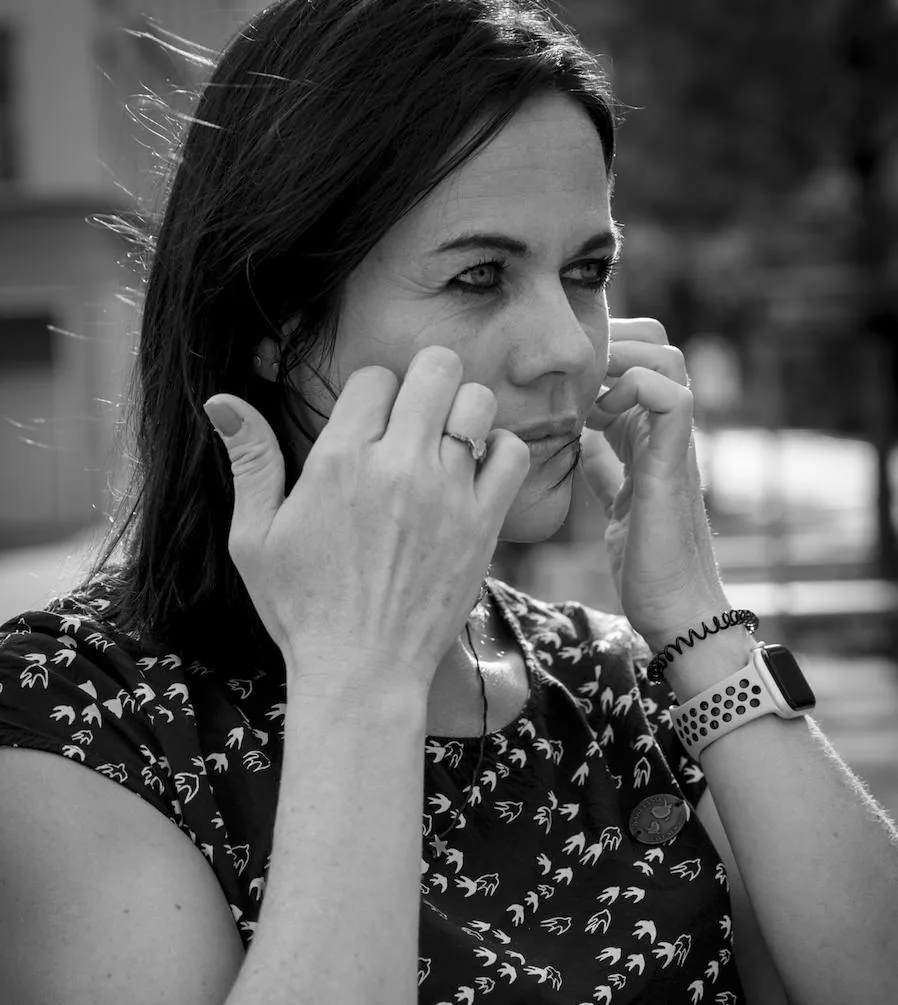
Portrait of Jolanda Spiess

Personal statement · 10 July 2026

The Federal Supreme Court confirms: Michele Binswanger's conviction for knowingly false allegation is final

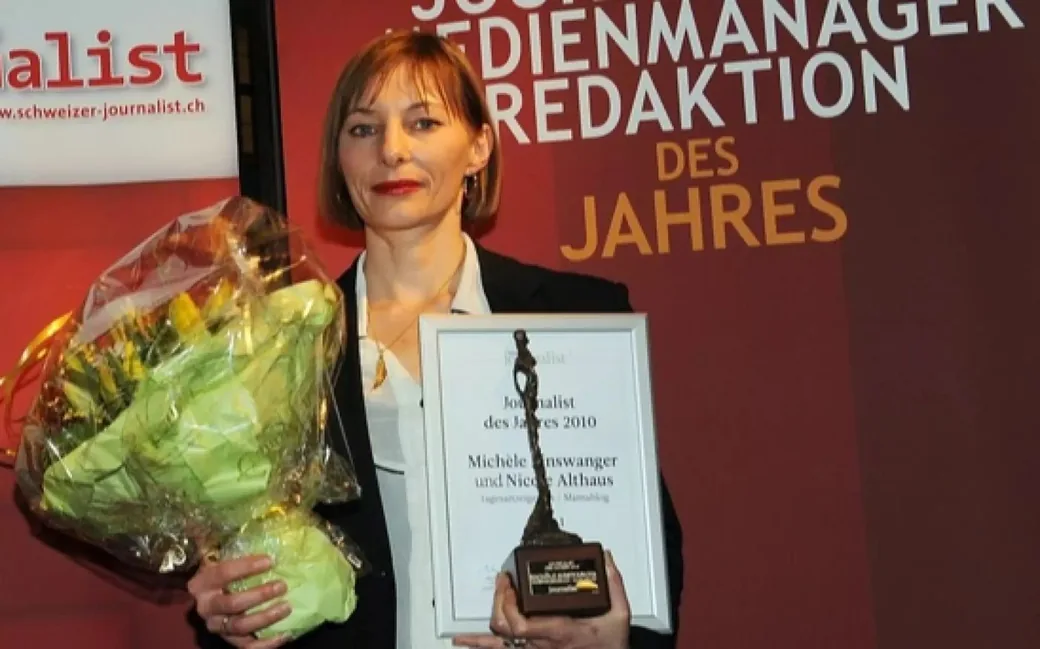
The Tamedia author Michele Binswanger now stands convicted of defamation; the conviction is final (judgment 6B_747/2025 of 2 June 2026).

Read the statement →

Context

Swiss media corporations will no longer be able to avoid returning profits generated from campaigns that violate personality rights.

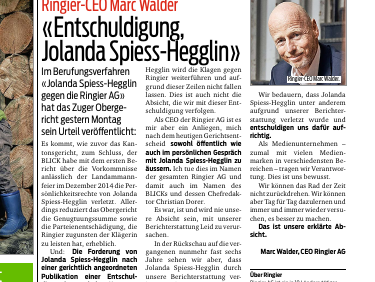
The ruling Jolanda Spiess secured against Ringier is not yet legally binding. However, endless tabloid smear campaigns, as experienced first-hand, are a thing of the past now that it is clear profits can be reclaimed retroactively.

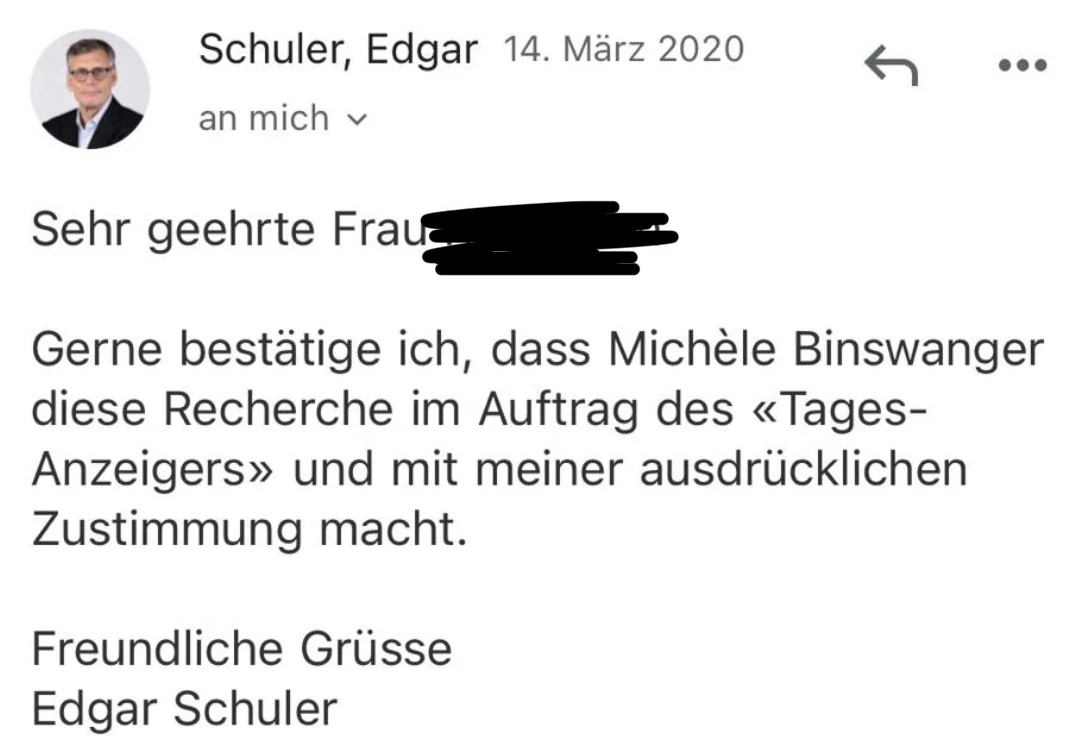
How painful this decision is for the media industry, which has never distanced itself from its lucrative tabloid operations, is demonstrated by the ongoing attempts to discredit and defame Jolanda Spiess through cross-corporation measures. A journalist who conducted a «research project» on the Zug Landammann reception «on behalf of» Tamedia has since been convicted of defamation – knowingly lying and deliberately making false claims; the Federal Supreme Court upheld the conviction on 2 June 2026 (ruling 6B_747/2025), making it final.

Proceedings against the Tamedia author and against various internet fringe figures who have united in media-fuelled hatred against Jolanda Spiess are still ongoing. Peace will likely only come once the profit disgorgement proceedings, which continue to drag on due to delaying tactics particularly by the media corporations, are concluded or a genuine settlement is reached.

Engagement, recognition, and new paths

For her commitment against hate speech and the founding of the organization #NetzCourage, Jolanda Spiess was awarded the Ida Somazzi Prize and the FemBizSwiss Award in 2021. Today she advises victims of media power abuse through Winkelried & Töchter GmbH and develops smart tools for legal documentation, research, and analysis – including for law firms. When she is not conducting proceedings, she cheers with her family for VfL Bochum – a club that never gives up.

Anyone engaged in a public and legal confrontation with the largest Swiss media houses cannot expect fair coverage of themselves or the ongoing proceedings. Those seeking an overview of the details of the individual proceedings, rulings, and documents can find them in the updated case dossiers below.

Case files

Five proceedings, fully documented.

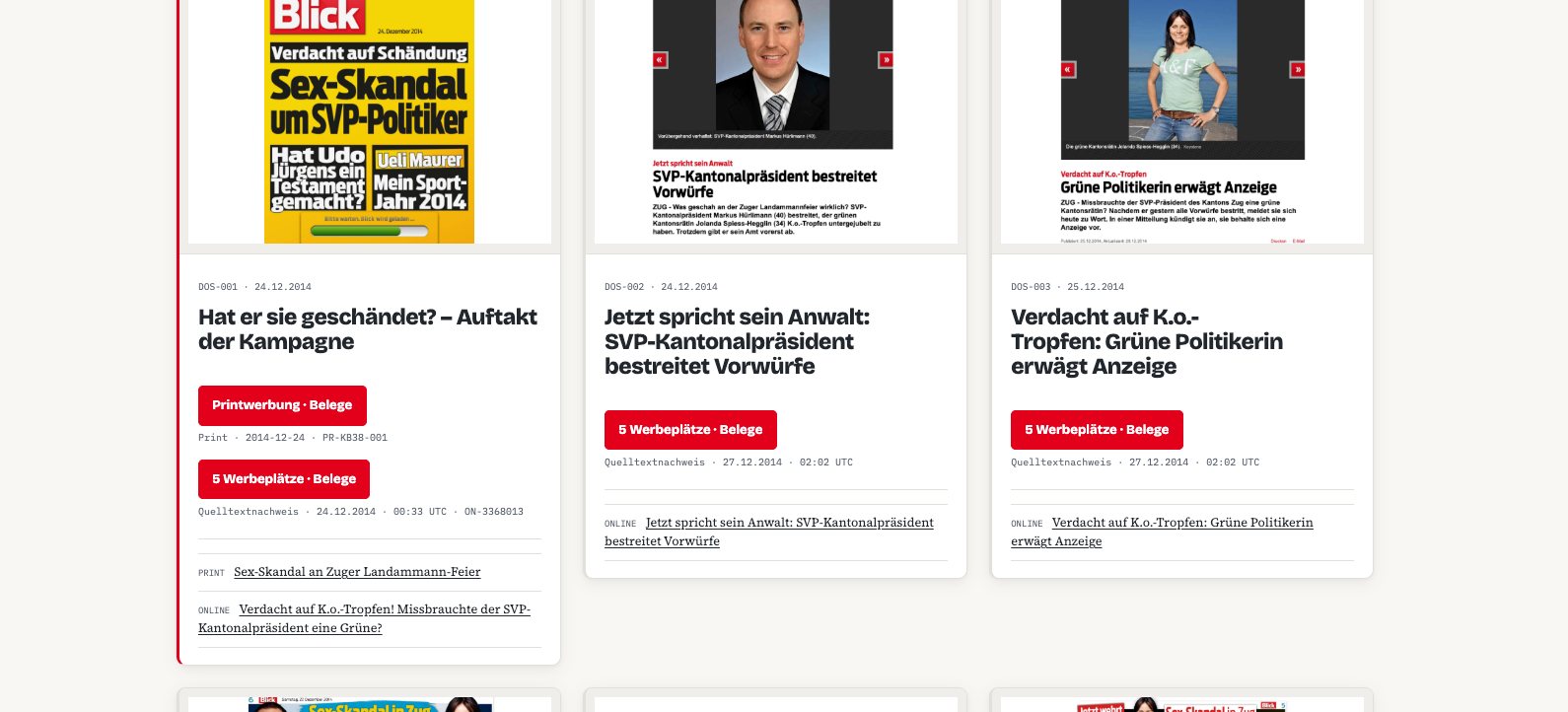
I document my media law proceedings against Swiss publishers here: with timelines, case numbers and rulings in full text. The landmark ruling on profit disgorgement has been confirmed on appeal: a media house must surrender the profit it generated with a personality rights violation.

  1. Ringier AG / Blick

    Case 01 · 2014 – today

    Landmark case · Leading judgment · Profit disgorgement

    Profit disgorgement under Art. 28a para. 3 ZGB, leading judgment · Personality rights violation final (High Court of Zug, 2020); profit disgorgement confirmed on appeal (High Court of Zug, 19 June 2026)

    Confirmed on appeal

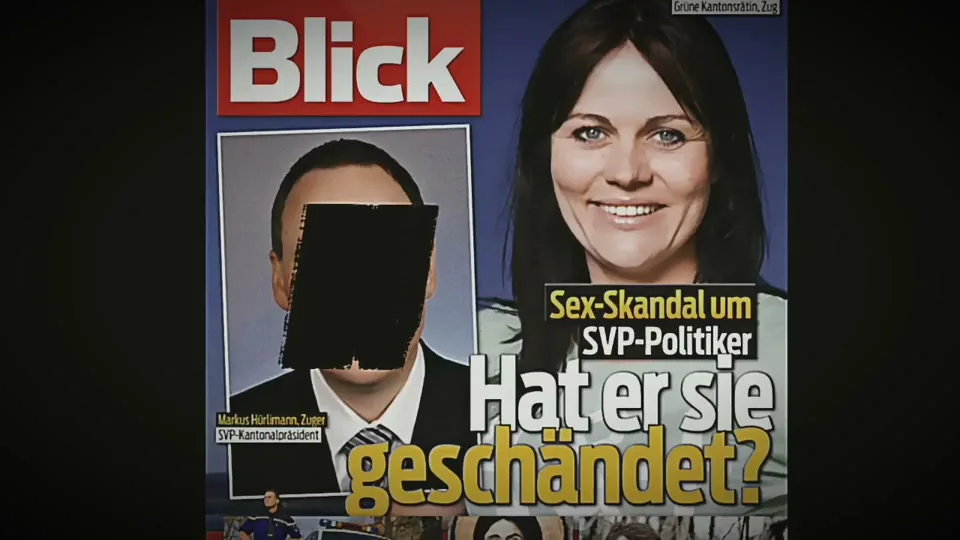
    Over 150 articles of a media campaign against a single person. Severe personality rights violation established by the court, Blick apology on the front page. For the first time in Switzerland, a media corporation is ordered to return profits from personality-violating reporting. On 19 June 2026, the High Court of Zug confirmed the profit disgorgement on appeal; not yet legally binding.

    Dossier → Ruling High Court Zug, 19.06.2026 (PDF) Ruling Cantonal Court Zug, 22.01.2025 (PDF)

  2. Tamedia / Binswanger

    Case 02 · 2020 – today

    Defamation · Media · Personality rights

    Defamation · Criminal conviction final (Federal Supreme Court, judgment 6B_747/2025 of 2 June 2026); civil claim pending

    Criminal law: final Civil claim (book): pending

    Final conviction for defamation, upheld by the Federal Supreme Court on 2 June 2026 (ruling 6B_747/2025). Ongoing civil lawsuit for nearly 200 personality-violating book passages and profit disgorgement.

    Dossier → Ruling Criminal Court Basel, 24.05.2023 (PDF) Ruling Court of Appeal Basel, 17.06.2025 (PDF)

  3. Cyberstalking and media hate connections

    Case 03 · 2019 – today

    Digital violence · Cyberstalking · Shameleaks

    Digital violence, documented over years · Partly final: civil personality rights violation against one perpetrator established with final effect (2024), numerous convictions; the criminal judgment of the Zurich High Court of 9 June 2026 and parts of the civil appeals are not yet legally binding

    Won repeatedly Partly final

    Over a dozen proceedings against systematic cyberstalking, pornography and the illegal publication of intimate data. Criminal threat. House searches, arrests, contact bans, convictions.

    Dossier → Ruling Cantonal Court Zug, 07.04.2026 (PDF)

  4. ECtHR Proceedings

    Case 04 · 2020 – today

    International · Human rights · Intimate privacy

    Application no. 21416/22 against Switzerland · Pending; Switzerland has submitted its observations

    Pending

    Complaint to the European Court of Human Rights – Switzerland has submitted its position. At the center: May a person's intimate privacy be declared public property simply because media have disseminated it for years?

    Dossier →

  5. Weltwoche / Deputy Editor

    Case 05 · 2015 – 2019

    Defamation · Media

    Defamation · Conviction in two instances, final (Zurich High Court, 2019); proceedings closed

    Final Closed

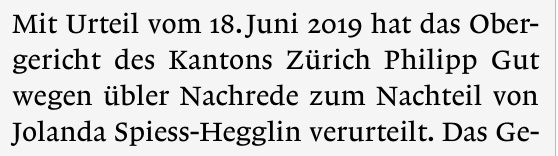
    Conviction in two instances for defamation. Documentation of how confidential investigation files were politically instrumentalized and published in coordination with an accused person.

    Dossier → Ruling High Court Zurich, 18.06.2019 (PDF)

From the file

What the courts have established.

Only someone who «knows for certain that the factual allegation is untrue» acts against better knowledge.

Federal Supreme Court, judgment 6B_747/2025 of 2 June 2026
  1. Federal Supreme Court upholds defamation conviction – final

    The Federal Supreme Court dismisses the Tamedia journalist's appeal (judgment 6B_747/2025 of 2 June 2026, five-judge panel). The defamation conviction is final: an untrue factual allegation, disseminated «with direct intent and against better knowledge». With a personal statement on the ruling.

  2. Profit disgorgement Ringier – High Court of Zug confirms on appeal

    The High Court of Zug confirms the profit disgorgement claim against Ringier AG (Art. 28a para. 3 ZGB): calculation method and principle confirmed, two calculation figures adjusted downward – on average around CHF 35,000 per article, plus five percent default interest since 2014/2015. Not yet legally binding (an appeal to the Federal Supreme Court is possible). With a personal statement on the ruling.

    Ruling High Court Zug, 19.06.2026 (PDF)

  3. Shameleaks criminal judgment – Zurich High Court

    The Zurich High Court upholds the pornography convictions against both perpetrators and reclassifies the coercion charge as criminal threat (Art. 180 SCC). Not yet legally binding (an appeal to the Federal Supreme Court remains possible).

  4. Cyberstalker's civil lawsuit dismissed in full

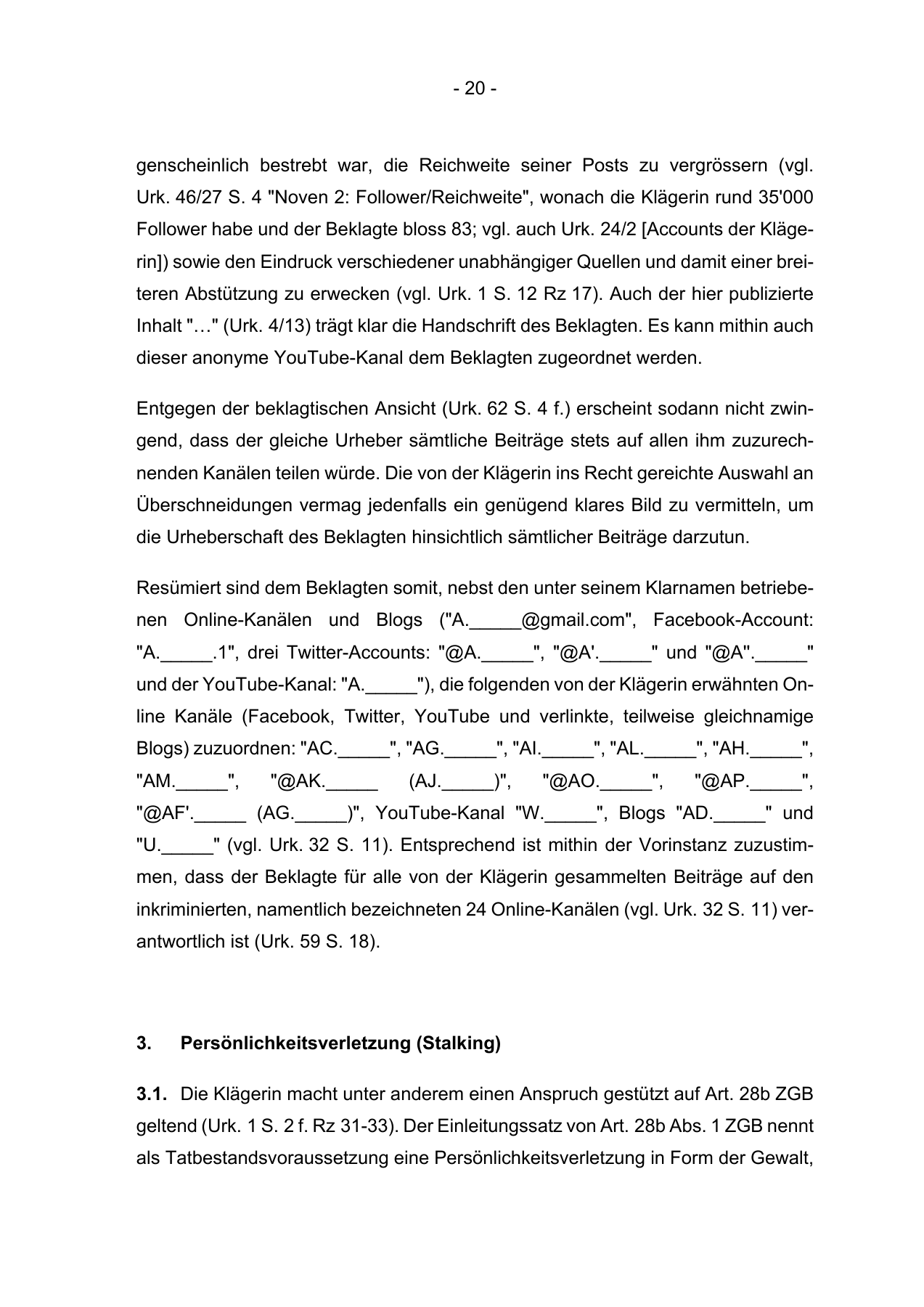
    Zug Cantonal Court dismisses the convicted stalker's civil lawsuit in full. Attempted perpetrator-victim reversal fails. Court confirms the right of stalking victims to publicly report documented violence. All costs imposed on the plaintiff.

    Ruling Cantonal Court Zug, 07.04.2026 (PDF)

  5. Profit disgorgement Blick – landmark ruling / leading judgment

    Ringier AG ordered to return profits from personality rights violations (Art. 28a para. 3 ZGB). For the first time in Swiss legal history. A leading judgment for media law and media ethics.

    Ruling Cantonal Court Zug, 22.01.2025 (PDF)

  6. Tamedia journalist – defamation confirmed in two instances

    Basel-Stadt Court of Appeal confirms the defamation conviction. The journalist appeals to the Federal Supreme Court.

    Ruling Court of Appeal Basel, 17.06.2025 (PDF)

  7. Shameleaks civil trial won

    Hinwil District Court rules in the civil trial on the illegal publication of intimate data in favor of Spiess-Hegglin.

    Ruling District Court Hinwil, 02.05.2025 (PDF)

  8. Penal order Solothurn – defamation

    Penal order by the Solothurn Public Prosecution for defamation in an Aktivradio interview. Upon objection, a first-instance acquittal, pending at the High Court.

    Penal order StA Solothurn, 02.09.2025 (PDF)

  9. SRF Documentary: Hate Online

    Documentary by Eveline Falk on digital violence and the legal fight against it.

    Watch the film (SRF Play)

  10. meistgeklickt – book publication

    Protocol of a system failure. Limmat Verlag. Documentation of the mechanisms behind media personality rights violations.

    To the book (Buchhaus)

  11. Cyberstalker convictions

    Pfäffikon District Court convicts both main perpetrators at first instance of pornography, one of them additionally of coercion; the defamation-related offences are time-barred.

    Ruling A (PDF) Ruling B (PDF)

  12. Swiss Government's observations to the ECtHR

    Switzerland submits 21 pages of observations on the complaint. The Federal Council defends the Federal Supreme Court's non-entry and requests dismissal – but concedes that Art. 6 ECHR (access to court) is applicable to the proceedings.

  13. ECtHR communicates complaint to Switzerland

    The ECtHR officially communicates the complaint to the Swiss government and submits a questionnaire: including whether access to the Federal Supreme Court was arbitrarily denied and whether the right to private life (Art. 8 ECHR) was violated.

  14. Complaint filed with the ECtHR

    Complaint filed with the European Court of Human Rights in Strasbourg on the protection of intimate privacy – in particular, whether Switzerland arbitrarily denied access to justice.

  15. Federal Supreme Court – non-entry (Urteil 5A_824/2021)

    Federal Supreme Court declined to hear the appeal on the grounds that the appellant had «not said a word» about the irreparable harm – even though this had been addressed on six pages. A legal article by Schulthess/Aeschimann/Cottinelli (AJP 09/2022) assesses the non-entry as «overly formalistic» – the harm was «patently obvious», the adjudication of the substantive questions unjustifiably refused.

  16. High Court Zug lifts preliminary injunction

    High Court Zug lifts the preliminary injunction against the personality-violating publication. Appeal filed with the Federal Supreme Court.

  17. Blick apology and High Court ruling

    High Court confirms «severe» intimate privacy violation. Ringier accepts. Blick apologizes on the front page.

    Blick apology, 25.08.2020 (PDF) Ruling High Court Zug, 18.08.2020 (PDF)

  18. Cantonal Court Zug – confirmation decision

    Zug Cantonal Court confirms the preliminary injunction in the ordinary proceedings (ES 2020 222, 3 September 2020). The publication ban protecting personality rights is maintained.

  19. Cantonal Court Zug – preliminary injunction

    Single judge at Zug Cantonal Court grants the request for provisional measures against the personality-violating book publication and issues orders to protect personality rights (4 May 2020).

  20. Weltwoche Deputy Editor convicted

    Conviction for defamation in two instances. Instrumentalization of confidential files documented.

    Ruling High Court Zurich, 18.06.2019 (PDF)

  21. Founding of #NetzCourage

    Jolanda Spiess founds the association #NetzCourage, which supports victims of digital violence and advocates for education and prevention.

Book

Book cover: meistgeklickt by Jolanda Spiess-Hegglin

Limmat Verlag · 2024

meistgeklickt

Protocol of a system failure

It began with a headline. Millions of clicks and advertising revenue for media corporations followed. The book documents how tabloid and quality media work hand in hand and describes the legal strategy of profit disgorgement.

Get the book →

Facts

Frequently asked questions

Who is Jolanda Spiess?

Jolanda Spiess – also known as Jolanda Spiess-Hegglin – is a Swiss strategist in media law, media ethics, and personality rights protection. She leads systemically relevant legal proceedings against Swiss media corporations such as Ringier and Tamedia, founded the organization #NetzCourage against digital violence in 2016, and works in strategic communication and organizational development through Winkelried & Töchter GmbH. Her book «meistgeklickt» was published in 2024 by Limmat Verlag.

What is the landmark ruling on profit disgorgement against Ringier?

For the first time in Swiss legal history, a media corporation – Ringier AG – was ordered to surrender profits from repeated personality-violating reporting. The Cantonal Court of Zug issued this ruling in 2025 under Art. 28a para. 3 SCC. The basis was over 150 articles from a media campaign for which a severe personality violation had already been judicially established. A central role was played by the expert report by Knecht/Baumann/Voigt: The journalist and media pioneer Hansi Voigt – founder of watson.ch, architect of We.Publish, and three-time Editor of the Year – together with other experts developed the analytical foundation that systematically documented for the first time how a publisher generated profits through personality-violating reporting. On 19 June 2026, the High Court of Zug confirmed the profit disgorgement on appeal and adjusted two calculation figures downward; the ruling is not yet legally binding (an appeal to the Federal Supreme Court is possible).

What does profit disgorgement mean in Swiss media law?

Profit disgorgement (Gewinnherausgabe) under Art. 28a para. 3 ZGB allows victims of personality rights violations to claim the profits the perpetrator made from the violation. In the Spiess vs. Ringier case, this was applied to media coverage for the first time. The legal principle had existed since 1983 but was never enforced – a dead letter that became living law through this landmark case.

What is the ECHR case of Jolanda Spiess?

The proceedings before the European Court of Human Rights (ECtHR) concern the civil case against the Tamedia book and the question of whether Switzerland arbitrarily denied Jolanda Spiess access to justice (Art. 6 ECHR) and whether the right to private life and intimate privacy (Art. 8 ECHR) was violated. Switzerland has submitted 21 pages of observations. The case is pending.

What does Jolanda Spiess do today?

Jolanda Spiess works through Winkelried & Töchter GmbH in strategic communication and organizational development. She continues her legal proceedings against Ringier (profit disgorgement), Tamedia/Binswanger (defamation, civil lawsuit), and at the ECHR. She develops smart tools for legal documentation, research, and analysis – including for law firms.

What is the book meistgeklickt about?

meistgeklickt (Most Clicked), published in 2024 by Limmat Verlag (ISBN 978-3-03926-083-6), documents how Swiss tabloid media – especially Ringier/Blick – conducted a years-long campaign against Jolanda Spiess-Hegglin. The book covers the legal proceedings, the media mechanisms, and the personal consequences. It is the first comprehensive account from the perspective of a person affected by systematic media personality rights violations in Switzerland.

What does Michele Binswanger have to do with the Spiess-Hegglin case?

Michele Binswanger is a Tamedia/Tages-Anzeiger author who conducted a so-called research project on the Zug incident «on behalf of» Tamedia. She was convicted of defamation in Basel-Stadt; the Federal Supreme Court upheld the conviction on 2 June 2026 (ruling 6B_747/2025), making it final. In Solothurn, an initial acquittal was followed by appeals from both the prosecution and Spiess – the case is now pending at the Higher Court. A civil lawsuit regarding nearly 200 personality-violating book passages and profit disgorgement is pending in Basel.

Is there a connection between the cyberstalkers and Michele Binswanger?

Court documents and communication records show that convicted cyberstalkers and Michele Binswanger operated in a shared ecosystem. Stalkers supplied Binswanger with material, Binswanger's publications fueled the stalkers' campaigns. This interplay between media coverage and digital violence is documented in detail in the book meistgeklickt and in the legal proceedings.

What is the media omertà in Switzerland?

Media omertà refers to the phenomenon whereby Swiss media corporations barely report critically on each other – especially not on proceedings that affect them directly. In the Spiess-Hegglin case, this pattern is striking: the landmark profit disgorgement ruling against Ringier was downplayed, distorted, or suppressed by large parts of the Swiss media. International outlets like ARD Tagesschau, FAZ, Süddeutsche Zeitung, Die Zeit, Der Standard, and taz reported extensively – the affected Swiss outlets barely or tendentiously. Even the connections between Tamedia and the author Michele Binswanger, whose defamation conviction became final when the Federal Supreme Court dismissed her appeal on 2 June 2026 (ruling 6B_747/2025), are barely covered – not even by so-called media journalists. The question remains how a Tamedia author can still be allowed to write about her target person after such a conviction. This structural silence protects the industry from accountability.

What happened in 2014 at the Zug Landammann reception?

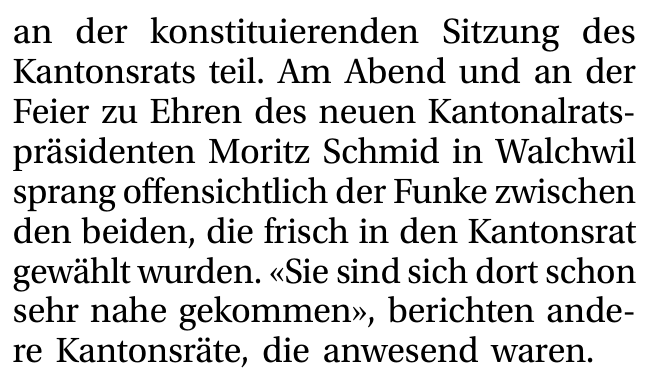
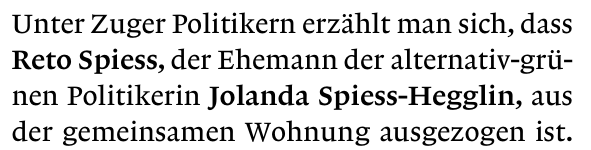
The morning after the Zug Landammann reception in December 2014, the newly elected cantonal councillor Jolanda Spiess woke up with an unexplained blackout and abdominal pain. At the hospital, DNA from two men was found in her intimate area. Date-rape drugs could neither be proven nor excluded – the blood sample was taken approximately twenty hours after the event, by which time substances like GHB would have long been metabolized. All criminal investigations against Spiess were dropped. She never accused anyone and assumes both parties involved were victims. The case was never solved. What followed was not investigation but an unprecedented media campaign: over 150 articles by Ringier/Blick alone, leading to a court-confirmed severe personality rights violation and the landmark profit disgorgement ruling. This case is a classic example of how a media campaign can disturb or even prevent proper judicial investigation – a problem that extends far beyond this individual case.

Glossary

Terms of Swiss media law such as profit disgorgement, personality rights violation and defamation, explained precisely and in citable form (in German): To the glossary →

Personal statement · 10 July 2026

The Federal Supreme Court confirms: Michele Binswanger's conviction for knowingly false allegation is final

The Tamedia author Michele Binswanger now stands convicted of defamation, and the conviction is final. Because – as the Federal Supreme Court, sitting as a five-judge panel, puts it – she disseminated an untrue factual allegation about me. Against better knowledge and with direct intent, as Lausanne confirmed in the last instance (judgment 6B_747/2025 of 2 June 2026).

Only someone who «knows for certain that the factual allegation is untrue» acts against better knowledge, the court writes.

The duty to truth is the first clause of the Swiss journalists' code of conduct. Defamation is its exact opposite.

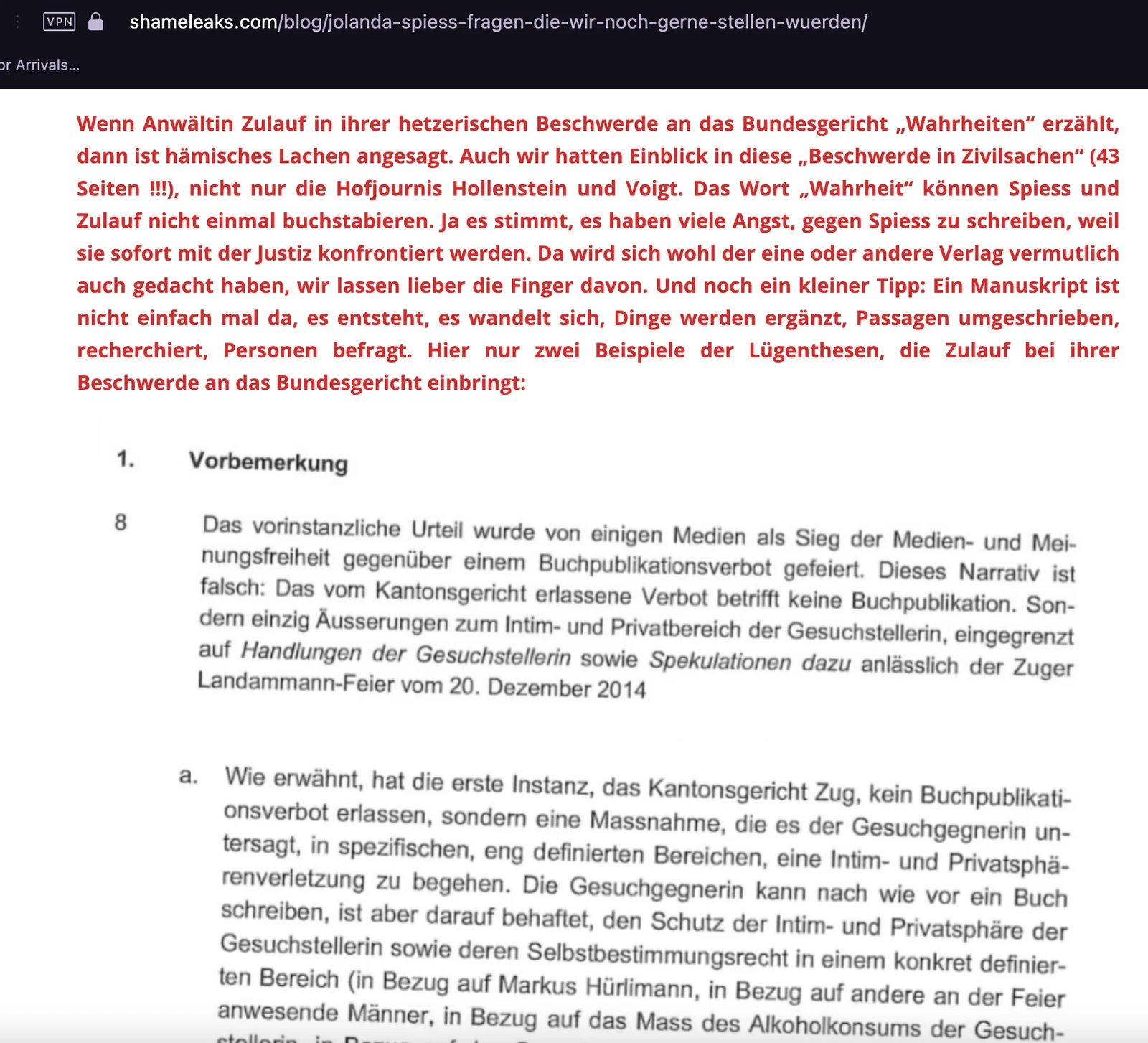
This false claim – that I had accused an SVP cantonal councillor of rape for years – made in a tweet six years ago, is at the same time the scaffolding on which the Tages-Anzeiger journalist Binswanger erected her entire media-friendly edifice of argument. With this false allegation she cast me as the perpetrator in the public eye. On the basis of this lie, Binswanger published a smear pamphlet in book form, disguised as «research». She undertook this pseudo-journalistic research on behalf of Tamedia.

The question arises whether this denigration of my person and credibility, pursued for years now, serves an industry interest. It is a fact that two weeks ago the second-highest court also ruled in my favour on every question of law against the other large Swiss media group, following our argument for the disgorgement of the profits illegally generated with my name.

Further proceedings against Michele Binswanger are still pending. I hope the Federal Supreme Court's decision – and the finding, hardly flattering for a journalist, of having spread a false allegation deliberately and against better knowledge – will finally bring the convicted Tamedia author to reason. And the Swiss publishing industry would do well to recognise that those affected by media abuse of power also obtain justice, and that even the largest publishing houses do not stand outside the law.

So today I have one more question, and I am not addressing it to the convicted journalist:

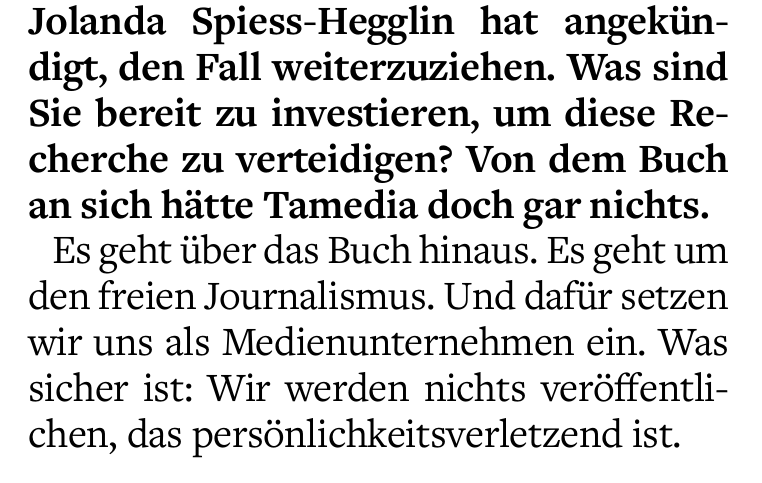
Tamedia, what does a final conviction for a deliberate, knowing lie (defamation) mean for your house's editorial responsibility and for your «research assignment» behind the published book?

Jolanda Spiess

Judgment 6B_747/2025 in full text → To the case file →

Contact

You can reach me.

For media inquiries, legal collaboration, or speaking engagements.

Press and media

Interview requests, background conversations, fact-checking.

Research and teaching

Rulings, materials, lectures.

Affected persons

Initial orientation in cases of digital violence and media attacks.

hallo@jolandaspiess.ch